
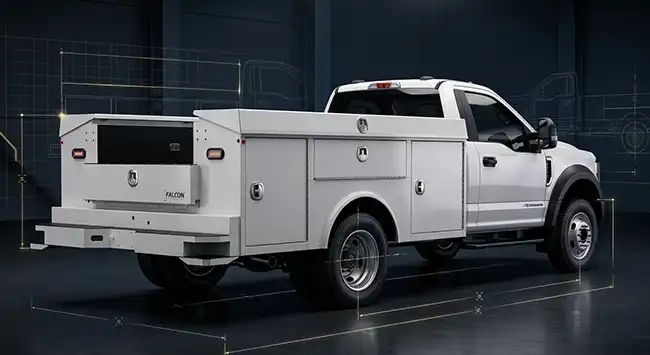
Service Body Sizing Guide: How to Choose the Right Body for Your Truck Chassis
Choosing a service body starts with the truck, but it does not end with the badge on the fender.
Knowing that you own a Ford F-350, Chevrolet Silverado 3500HD, GMC Sierra 3500HD, or Ram 3500 is helpful. It is not enough, however, to determine which service body will fit correctly or how much equipment the completed truck can safely carry.
Two trucks with the same model designation can have different cab configurations, wheelbases, frame layouts, rear-axle ratings, payload capacities, and cab-to-axle dimensions. One may be a standard pickup with the factory bed removed. Another may be a purpose-built chassis cab designed specifically for commercial upfitting.
Those differences directly affect:
Service-body length
Body width and wheel-well design
Mounting requirements
Weight distribution
Available payload
Compartment capacity
Crane and accessory compatibility
Towing and hitch configuration
The right body should fit the chassis, support the equipment you carry, and remain within the truck manufacturer’s weight and dimensional limits.
This guide explains the measurements and specifications buyers should understand before selecting a service body.
Start With the Exact Truck Configuration
Before comparing service-body models, identify the truck you are actually working with.
At a minimum, gather:
- Model year
- Make and model
- Regular, extended, or crew cab
- Pickup or chassis-cab configuration
- Two-wheel drive or four-wheel drive
- Single rear wheel or dual rear wheel
- Wheelbase
- Cab-to-axle measurement
Gross Vehicle Weight Rating
- Front and rear Gross Axle Weight Ratings
- Engine and drivetrain
- Factory fuel-tank configuration
- Planned towing requirements
A model name alone cannot provide all of this information.
An F-350 crew-cab pickup, for example, is not dimensionally identical to an F-350 regular-cab chassis cab. Even when both trucks have similar powertrains and weight ratings, the frame behind the cab may be designed for a completely different type of body installation.
The safest starting point is the vehicle’s VIN, certification labels, OEM specifications, and physical chassis measurements.
Pickup Box Removal vs. Factory Chassis Cab
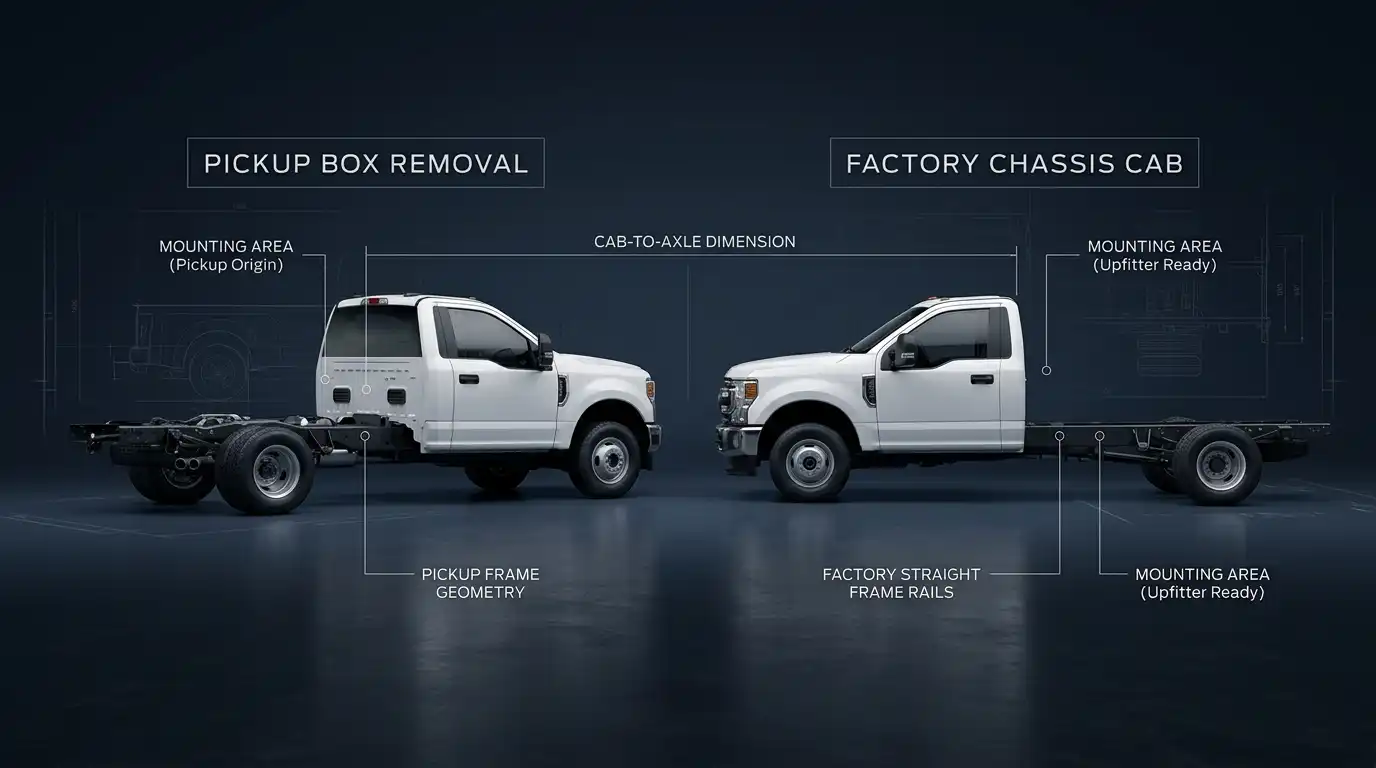
One of the first questions to answer is whether the truck began as a complete pickup or as an incomplete chassis cab.
Although both can sometimes be equipped with commercial bodies, they are not interchangeable platforms.
Pickup Box Removal
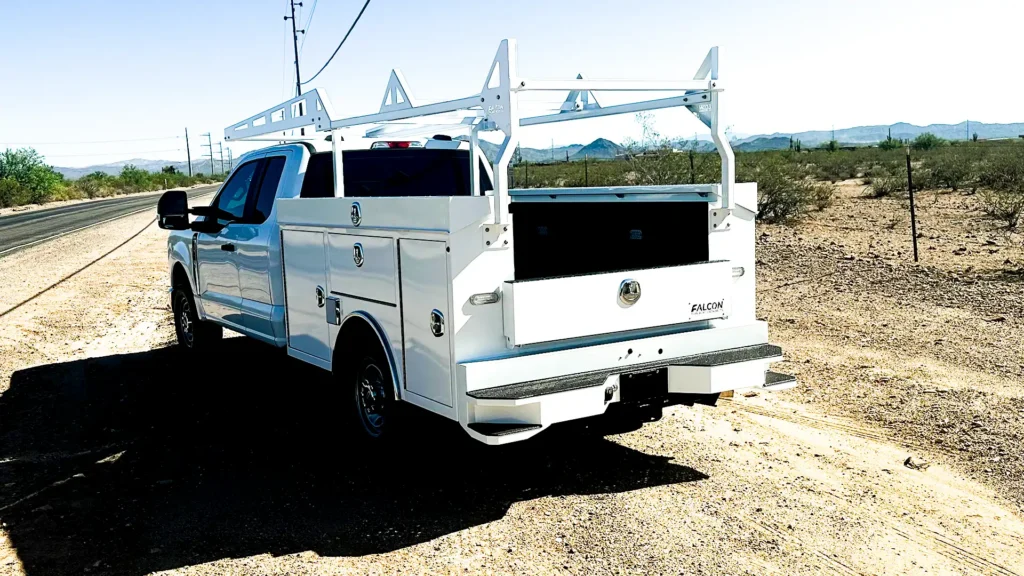
A pickup box removal, sometimes called a bed-delete or bed-off installation, begins with a conventional pickup truck. The original factory bed is removed and replaced with a service body designed for that particular pickup configuration.
Pickup frames may include:
- Frame contours or changes in rail height
- Suspension or chassis components above or outside the frame
- Fuel-fill plumbing positioned for the original pickup bed
- Factory bumper and hitch provisions
- Spare-tire equipment
- Sensors, cameras, wiring, and lighting connections
- Different clearances around the cab and rear axle
The available space behind the cab also depends on the truck’s cab and original bed configuration. A pickup originally equipped with an 8-foot bed commonly provides a different cab-to-axle dimension than a truck equipped with a shorter bed.
For that reason, buyers should not assume that every pickup automatically has a 56-inch CA.
Factory Chassis Cab
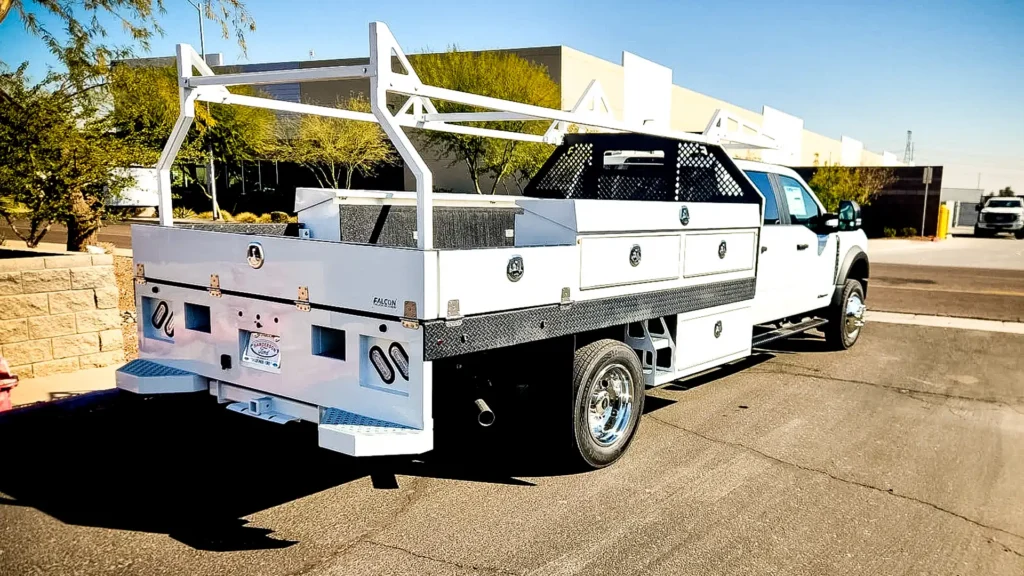
A chassis cab is supplied without a pickup bed and is intended to receive a vocational body from an intermediate- or final-stage manufacturer.
Depending on the manufacturer and chassis class, it may provide:
- Straight, parallel frame rails behind the cab
- A comparatively clean mounting surface
- Standardized frame spacing
- Commercial rear suspension
- Multiple wheelbase and cab-to-axle options
- Upfitter wiring and auxiliary switch provisions
Greater flexibility for service, mechanics, platform, dump, and other vocational bodies
The work-truck industry commonly uses established cab-to-axle dimensions because they allow body manufacturers and upfitters to plan body length, compartment placement, axle clearance, and mounting. Exact dimensions must still be confirmed using current OEM body-builder information and the individual vehicle.
Why the Difference Matters
A body designed around a particular chassis-cab frame should not be assumed to fit a pickup-frame application simply because the two trucks have similar model names.
Differences in rail geometry, axle position, fuel equipment, suspension clearance, body mounts, bumper location, and electrical architecture may require a different body design or mounting system.
The question is not simply:
“Will a nine-foot body fit an F-350?”
The better question is:
“Will this specific body fit this exact F-350 configuration while maintaining proper clearance, weight distribution, and regulatory compliance?”
The Most Important Service-Body Measurements
1. Cab-to-Axle Measurement
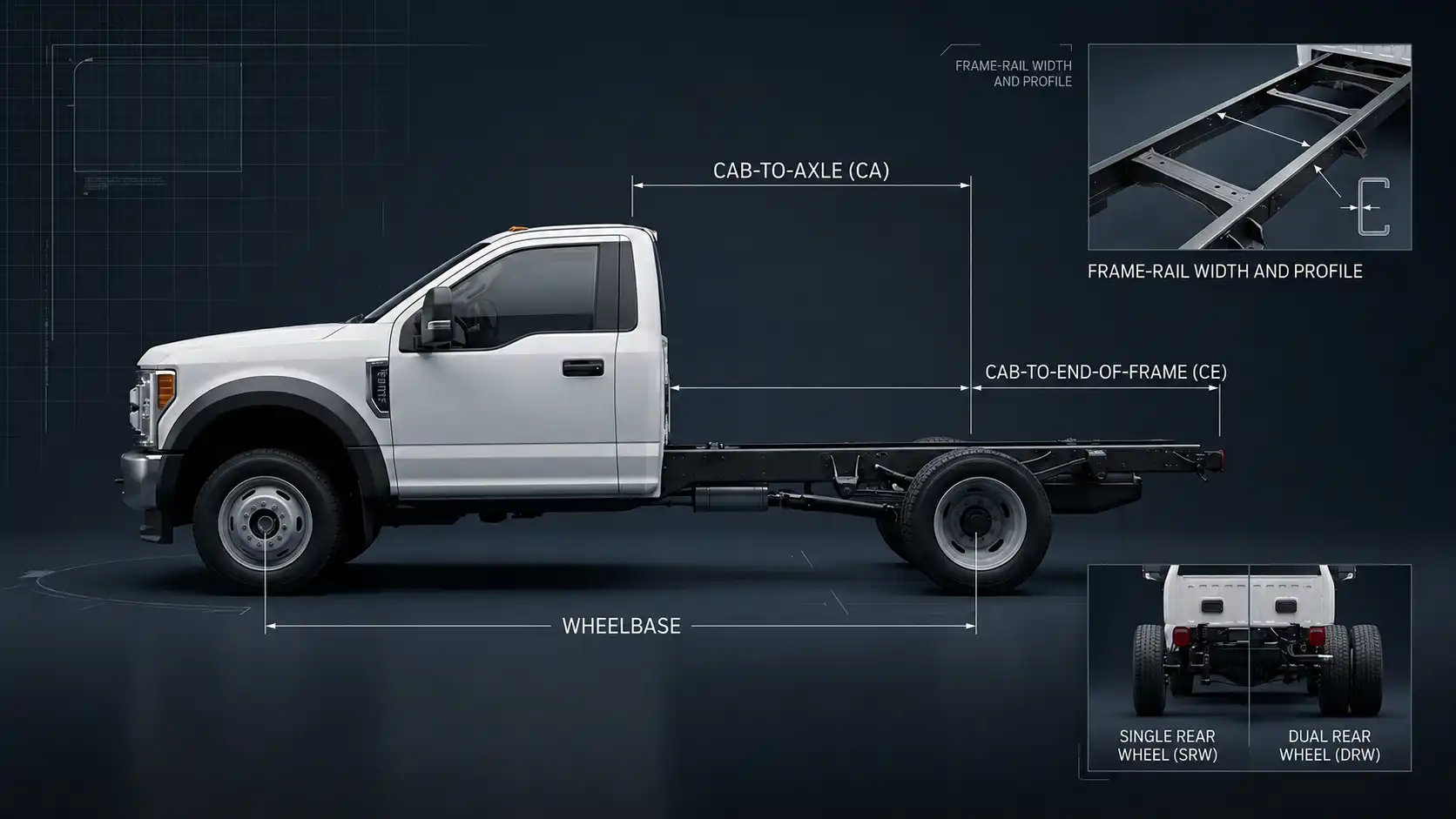
Cab-to-axle, commonly abbreviated as CA, is the nominal distance from the rear of the cab to the centerline of the rear axle.
For a truck with tandem rear axles, the corresponding measurement is generally taken to a point between the axles.
CA is one of the most important dimensions in body selection because it helps determine:
- Where the wheel opening must be positioned
- How much body can extend in front of and behind the rear axle
- The appropriate body length
- Rear overhang
- Load distribution
- Compartment layout
- Crane and equipment placement
Common chassis-cab CA dimensions include configurations such as 60, 84, 108, and other application-specific lengths. Pickup box-removal applications may use different measurements depending on the original cab and bed combination.
These dimensions should be treated as starting points, not universal rules.
How to Measure CA
Measure horizontally from the rear surface of the cab to the centerline of the rear axle.
Use the actual cab surface specified by the OEM or body manufacturer. Do not measure from:
- A rear bumper
- A cab step
- A temporary accessory
- A sleeper extension unless specifically included
- The end of the frame
Also inspect the area immediately behind the cab. Exhaust components, emissions equipment, fuel tanks, batteries, suspension parts, or other obstructions can reduce the usable mounting space even when the nominal CA appears correct.
2. Wheelbase
Wheelbase is the distance between the centerline of the front axle and the centerline of the rear axle.
CA helps match the body to the area behind the cab. Wheelbase helps define the truck’s complete chassis layout.
Wheelbase affects:
- Turning radius
- Maneuverability
- Front- and rear-axle loading
- Body length
- Rear overhang
- Center of gravity
- Ride and handling
- Overall vehicle length
A longer wheelbase may provide room for a longer body or additional equipment, but it can also reduce maneuverability in tight job sites.
A shorter wheelbase may be easier to operate in urban environments, alleys, construction sites, or crowded service areas, but it can limit body and equipment options.
Neither is automatically better. The correct wheelbase depends on the work the truck must perform.
3. Cab-to-End-of-Frame Measurement
Cab-to-end-of-frame, sometimes abbreviated as CE, measures from the back of the cab to the rear end of the frame.
This dimension helps determine whether the frame provides enough support for the selected body and whether an extension or modification may be required.
It also affects:
- Rear bumper placement
- Hitch installation
- Towing configuration
- Rear step design
- Body overhang
- Lighting and underride requirements
- Clearance for stored equipment
A body may align correctly with the axle and still require additional planning at the rear of the chassis.
4. Frame-Rail Width and Profile
Many full-size chassis cabs use frame rails designed around common vocational-body mounting practices. Pickup frames can have different widths, contours, brackets, and obstructions.
The installer should confirm:
- Outside frame width
- Inside frame width
- Rail height
- Rail thickness
- Frame material
- Crossmember locations
- Frame kick-ups or tapers
- Suspension travel clearance
- OEM no-drill or no-weld areas
- Required mounting methods
A flat service-body floor does not mean it can be bolted directly to any truck frame.
Body installation must follow the mounting instructions supplied by the body manufacturer and the applicable OEM body-builder guidance.
5. Single Rear Wheel vs. Dual Rear Wheel
Rear-wheel configuration affects more than appearance. It influences service-body width, wheel-opening dimensions, stability, axle capacity, and compartment depth.
Single Rear Wheel
A single-rear-wheel truck has one tire on each side of the rear axle.
An SRW body is generally narrower and may be well suited for:
- Lighter service applications
- Residential or urban work
- Tighter roads and job sites
- Fleets prioritizing maneuverability
- Applications with moderate tools and inventory
Actual body width and floor dimensions vary by body model and chassis.
Dual Rear Wheel
A dual-rear-wheel truck has two tires on each side of the rear axle.
A DRW configuration generally provides:
- A wider rear track
- Greater rear-axle capacity in many configurations
- Increased stability under heavy loads
- Compatibility with wider service bodies
- Deeper side compartments on certain body designs
- Better support for heavier equipment packages
A DRW truck does not automatically mean that any heavy service body or crane package is acceptable. The completed vehicle must still remain within its GVWR, individual axle ratings, tire ratings, center-of-gravity limits, and other OEM requirements.
Body Length: What Does an 8-, 9-, or 11-Foot Service Body Mean?
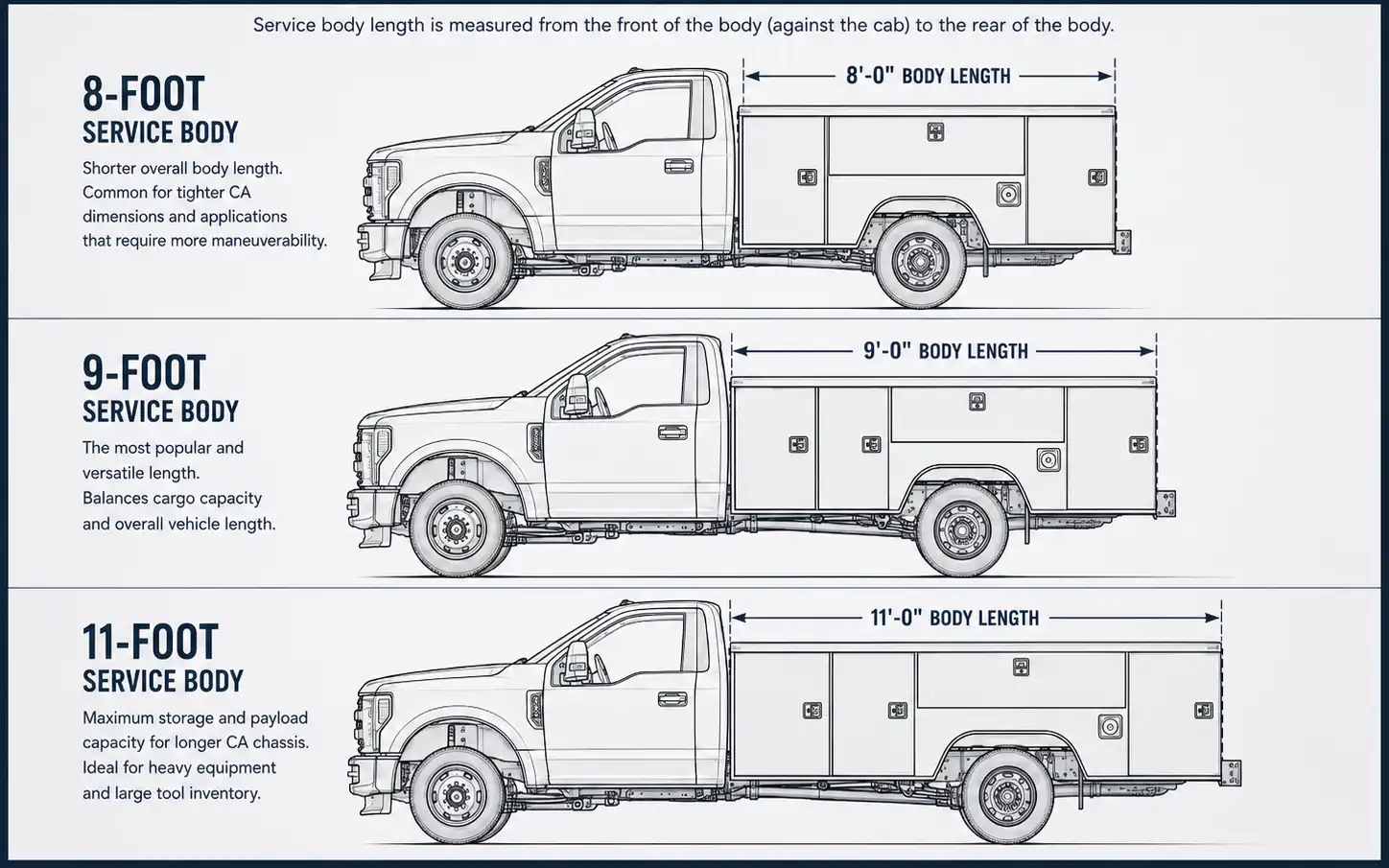
Service bodies are commonly described by nominal body length.
Typical examples include:
- 8-foot service bodies
- 9-foot service bodies
- 11-foot service bodies
- 13-foot and longer heavy-duty bodies
Body length influences:
- Number and size of compartments
- Horizontal storage capacity
- Rear overhang
- Load space
- Weight
- Chassis requirements
- Accessory placement
- Crane and outrigger options
As a general planning concept:
- Typical Chassis Application
- Common CA Range
- Common Body-Length Category
- Full-size pickup box removal
- Varies by cab and original bed
- Often 8-foot class
- Short chassis cab
- Around 60 inches
- Often 9-foot class
- Longer chassis cab
- Around 84 inches
- Often 11-foot class
- Extended heavy-duty chassis
- 108 inches and longer
- Often 13-foot or longer
This table is not a fitment guarantee.
Body-to-chassis compatibility varies by:
- Manufacturer
- Body design
- Cab style
- Chassis model
- Rear-wheel configuration
- Frame length
- Intended load
- Mounting system
- Accessories
- Required rear overhang
Falcon Truck Bodies or the installing upfitter should verify the final combination before the body is ordered or mounted.
Weight Ratings: The Body Must Fit the Payload, Too
A body can fit the frame dimensionally and still be the wrong choice for the truck.
The completed vehicle must be evaluated by weight as well as size.
Gross Vehicle Weight Rating
The Gross Vehicle Weight Rating, or GVWR, is the maximum allowable weight of the completed vehicle as established by the vehicle manufacturer.
That completed weight can include:
- Chassis
- Service body
- Driver and passengers
- Fuel and operating fluids
- Tools
- Parts and inventory
- Crane
- Outriggers
- Welder
- Compressor
- Generator
- Fluid tanks
- Hitch equipment
- Cargo
- Other installed accessories
GVWR should never be treated as the amount of cargo the truck can carry. The truck, body, occupants, equipment, and cargo all consume part of that rating.
Gross Axle Weight Ratings
The Gross Axle Weight Rating, or GAWR, is the maximum allowable weight carried by an individual axle system.
A truck can be below its total GVWR and still overload the front or rear axle if weight is distributed poorly.
This is especially important when installing:
- A service crane
- Outriggers
- A large welder-generator
- An air compressor
- Fluid or fuel tanks
- Heavy drawer systems
- Dense parts inventory
- A rear-mounted hitch load
- Equipment concentrated on one side
Final-stage weight calculations should consider both total vehicle weight and the amount carried by each axle.
Available Payload
For preliminary chassis selection, payload is often estimated as:
Available payload = GVWR − chassis or vehicle curb weight
That calculation can be useful during planning, but it does not tell the entire story.
After the body and permanent equipment are installed, the more practical calculation is:
Remaining payload = GVWR − actual completed vehicle weight
The most reliable way to confirm the completed vehicle’s operating weight is to weigh it in its working configuration and compare:
- Total scale weight with GVWR
- Front-axle scale weight with front GAWR
- Rear-axle scale weight with rear GAWR
- Tire and wheel ratings with the loads they carry
The body’s published weight should also be confirmed for the exact model and option package. Shelving, bumpers, hitches, cranes, outriggers, compressors, welders, drawers, racks, and other accessories can materially change the completed weight.
Build a Realistic Payload Budget
Many buyers calculate the body weight but underestimate everything that will go inside or on top of it.
Before selecting the chassis, create a complete equipment list.
Include:
- Service-body base weight
- Bumper and hitch
- Shelving and drawer systems
- Ladder or material rack
- Crane
- Crane reinforcement
- Outriggers
- Welder or generator
- Air compressor
- Hydraulic equipment
- Fuel, oil, water, or recovery tanks
- Hoses, reels, and cables
- Replacement parts
- Fasteners and consumables
- Hand tools
- Power tools
- Driver and passengers
- Trailer tongue weight
- Future equipment additions
Use verified manufacturer weights whenever available. Avoid relying on broad estimates for final engineering or purchasing decisions.
A truck that appears adequate when empty can quickly run out of payload after the body, equipment, tools, and inventory are installed.
It is generally better to evaluate the complete working truck at the beginning than to discover after installation that the chassis is too light for the intended application.
Weight Distribution Matters as Much as Total Weight
Where the weight is placed can be just as important as how much the equipment weighs.
A heavy component mounted far behind the rear axle can add substantial load to the rear axle while reducing weight on the front axle. A crane or equipment package mounted heavily to one side can affect lateral balance. A tall load can raise the vehicle’s center of gravity and alter handling.
Consider:
- Fore-and-aft weight distribution
- Left-to-right balance
- Front-axle loading
- Rear-axle loading
- Horizontal center of gravity
- Vertical center of gravity
- Lateral center of gravity
- Rear overhang
- Trailer tongue weight
- Loads created while a crane is operating
This is one reason crane bodies and heavily equipped mechanics bodies require more planning than a standard storage body.
The chassis must support not only the weight of the equipment while driving, but also the forces created when that equipment is being used.
Which Falcon Service Body Fits Your Chassis?
The following table provides a general starting point for discussing Falcon body sizes.
- Chassis Configuration
- Rear-Wheel Configuration
- Typical CA Category
- Possible Body Category
- Full-size pickup box removal
- SRW
- Confirm exact pickup configuration
- 8-foot-class SRW body
- Full-size pickup box removal
- DRW
- Confirm exact pickup configuration
- 8-foot-class DRW body
- Class 3–5 chassis cab
- SRW or DRW
- Around 60 inches
- 9-foot-class body
- Class 4–6 chassis cab
- Commonly DRW
- Around 84 inches
- 11-foot-class body
- Extended Class 5–7 chassis
- Commonly DRW
- 108 inches or longer
- 13-foot or longer heavy-duty body
This table should be used to begin a conversation, not to place an order without verification.
Final selection depends on the exact Falcon model, truck VIN, CA, wheelbase, frame layout, rear-wheel configuration, body weight, equipment package, axle ratings, center of gravity, and intended use.
What Falcon Needs to Confirm Fitment
Providing complete information at the beginning can prevent delays and reduce the risk of ordering the wrong body.
Before contacting Falcon or an authorized distributor, gather:
Truck Information
- Year
- Make
- Model
- VIN
- Cab configuration
- Pickup or chassis cab
- Two-wheel drive or four-wheel drive
- SRW or DRW
- Wheelbase
- Cab-to-axle measurement
- Cab-to-end-of-frame measurement
- GVWR
- Front GAWR
- Rear GAWR
Application Information
- Industry or trade
- Typical tools and inventory
- Expected payload
- Number of occupants
- Towing requirements
- Work environment
- Desired compartment layout
- Need for open load space
- Need for an enclosed body
- Ladder- or material-rack requirements
Equipment Information
- Crane capacity and reach
- Welder or generator
- Compressor
- Outriggers
- Fluid tanks
- Hose reels
- Drawer systems
- Hitch
- Bumper
- Lighting
- Inverter or auxiliary power
- Planned future equipment
The more complete the information, the more accurately the body and chassis can be matched.
Additional Fitment Details an Upfitter Must Check
Even after body length and payload appear correct, several installation details still require review.
Fuel-System Clearance
The body and mounting hardware must allow adequate clearance for:
- Fuel tanks
- Filler necks
- Vent lines
- Diesel exhaust fluid equipment
- Pumps and sending units
- Required service access
Fuel components should not be relocated or modified without following OEM instructions.
Exhaust and Emissions Equipment
Modern commercial trucks may have exhaust, aftertreatment, heat shields, sensors, and emissions equipment positioned along the frame.
The installation must preserve:
- Heat clearance
- Airflow
- Service access
- Sensor operation
- OEM routing requirements
Electrical Integration
The body may need to interface with:
- Taillights
- Marker lights
- Backup lights
- Cameras
- Parking sensors
- Trailer wiring
- Auxiliary switches
- Power takeoff controls
- Crane or compressor circuits
- Body lighting
- Strobe or warning systems
Modern vehicle electronics should be integrated using OEM-approved connection points and upfitter guidance.
Bumper, Hitch, and Towing
A service body can change the rear structure of the truck.
The upfitter must confirm:
- Bumper position
- Step height
- Receiver-hitch compatibility
- Hitch rating
- Trailer-plug location
- Safety-chain attachment
- Camera and sensor placement
- License-plate visibility
- Rear lighting
The truck’s tow rating does not automatically remain unchanged after adding a body and equipment. Actual towing capacity depends on the completed vehicle weight, axle loads, hitch configuration, and OEM limits.
Tire and Suspension Clearance
The body must maintain adequate clearance through the suspension’s full range of movement.
This includes clearance around:
- Tires
- Inner dual tires
- Suspension components
- Brake lines
- Shock absorbers
- Jounce travel
- Mud flaps
- Wheel openings
Body-to-Cab Clearance
Enough space must remain between the cab and body to account for:
- Frame movement
- Cab movement
- Drivetrain movement
- Service access
- Heat
- Mounted accessories
The body should never be positioned by appearance alone.
Why Final Fitment Should Be Professionally Verified
Correctly upfitting a commercial truck requires the body manufacturer, chassis manufacturer, installer, and final-stage manufacturer to work from the same specifications.
Professional verification helps ensure:
- The wheel opening aligns with the rear axle
- The body mounts correctly to the frame
- Tires and suspension have adequate clearance
- Fuel and emissions equipment remain serviceable
- Electrical systems are integrated correctly
The completed vehicle remains within applicable weight ratings
- Front- and rear-axle loads are acceptable
- Center-of-gravity requirements are considered
Bumpers, hitches, lights, cameras, and sensors function properly
- Required vehicle certification responsibilities are addressed
OEM body-builder information and the vehicle’s Incomplete Vehicle Document may establish requirements that the final-stage manufacturer must follow when completing a chassis cab.
That is why selecting a body from a simple year-make-model lookup is rarely sufficient for a commercial build.
Common Service-Body Sizing Mistakes
Choosing the Body Before Confirming the Chassis
A buyer finds a service body first and then tries to locate a truck that will carry it.
This can work, but only when the complete body and equipment specifications are available. Otherwise, important weight or dimensional requirements may be missed.
Assuming Every One-Ton Truck Is the Same
“One ton” is an informal description, not a complete chassis specification.
A one-ton SRW pickup and a one-ton DRW chassis cab may differ significantly in frame layout, axle rating, payload, CA, and body compatibility.
Looking Only at GVWR
GVWR is important, but so are:
- Front GAWR
- Rear GAWR
- Tire ratings
- Wheel ratings
- Center of gravity
- Weight distribution
- Hitch limits
Forgetting Equipment Weight
The service body may be only one part of the finished build.
Cranes, outriggers, compressors, welders, tanks, drawers, tools, and inventory must all be included.
Planning for Today but Not Tomorrow
A truck may leave the shop within its ratings and become overloaded six months later as more tools, parts, and equipment are added.
Include realistic operating inventory and likely future additions during the original chassis-selection process.
Treating Approximate Measurements as Final
A few inches can affect wheel-opening alignment, compartment placement, bumper fitment, and frame support.
Use verified OEM dimensions and physical measurements before ordering.
Service Body Sizing Frequently Asked Questions
Can I put a service body on a regular pickup?
In many cases, yes. The body must be specifically designed or approved for the truck’s pickup-frame configuration, cab-to-axle dimension, wheel arrangement, and payload capacity. A body intended for a chassis cab should not automatically be treated as compatible with a pickup.
Is an F-350 large enough for a service body?
Some F-350 configurations can support service bodies, but the model name alone does not determine compatibility. The exact cab, frame, CA, wheelbase, SRW or DRW arrangement, GVWR, axle ratings, body weight, equipment, and payload must be evaluated.
What body fits a 60-inch CA chassis?
A 60-inch CA is commonly associated with a 9-foot-class vocational body, but the exact body must be confirmed against the chassis and body manufacturer’s specifications.
What body fits an 84-inch CA chassis?
An 84-inch CA is commonly used with an 11-foot-class body. Final compatibility still depends on frame length, rear overhang, axle ratings, body design, equipment, and intended application.
Do I need a DRW truck for a service body?
Not always. Lighter service-body applications may be suitable for certain SRW trucks. Heavier bodies, deeper compartments, cranes, and larger equipment packages commonly require the additional capacity and stability available from an appropriate DRW chassis.
How do I know how much payload remains after installation?
Subtract the actual completed vehicle weight from the chassis GVWR, then verify the load carried by each axle against its GAWR. The completed truck should ideally be weighed with fuel, permanent equipment, and a representative operating load.
Can I add a crane later?
Possibly, but a future crane should be considered during the original body and chassis selection. Crane installation may require structural reinforcement, outriggers, hydraulic or electrical systems, additional payload, and specific center-of-gravity and stability considerations.
Confirm Your Chassis and Body Combination With Falcon
The right service body should do more than physically sit on the frame. It should support the tools, equipment, materials, and daily demands of the people who depend on it.
Before ordering, confirm:
- The exact chassis configuration
- Cab-to-axle measurement
- Wheelbase
- Frame layout
- SRW or DRW body width
- GVWR and axle ratings
- Body and equipment weight
- Payload requirements
- Crane or accessory needs
- Towing requirements
- Mounting and electrical compatibility
Falcon Truck Bodies can help review your chassis specifications, intended application, equipment package, and storage requirements to identify an appropriate body size and configuration.
Contact Falcon Truck Bodies with your truck information and build requirements to begin planning a service body designed around the work your truck needs to perform.
Related Posts



Leave a Reply